Quick answer
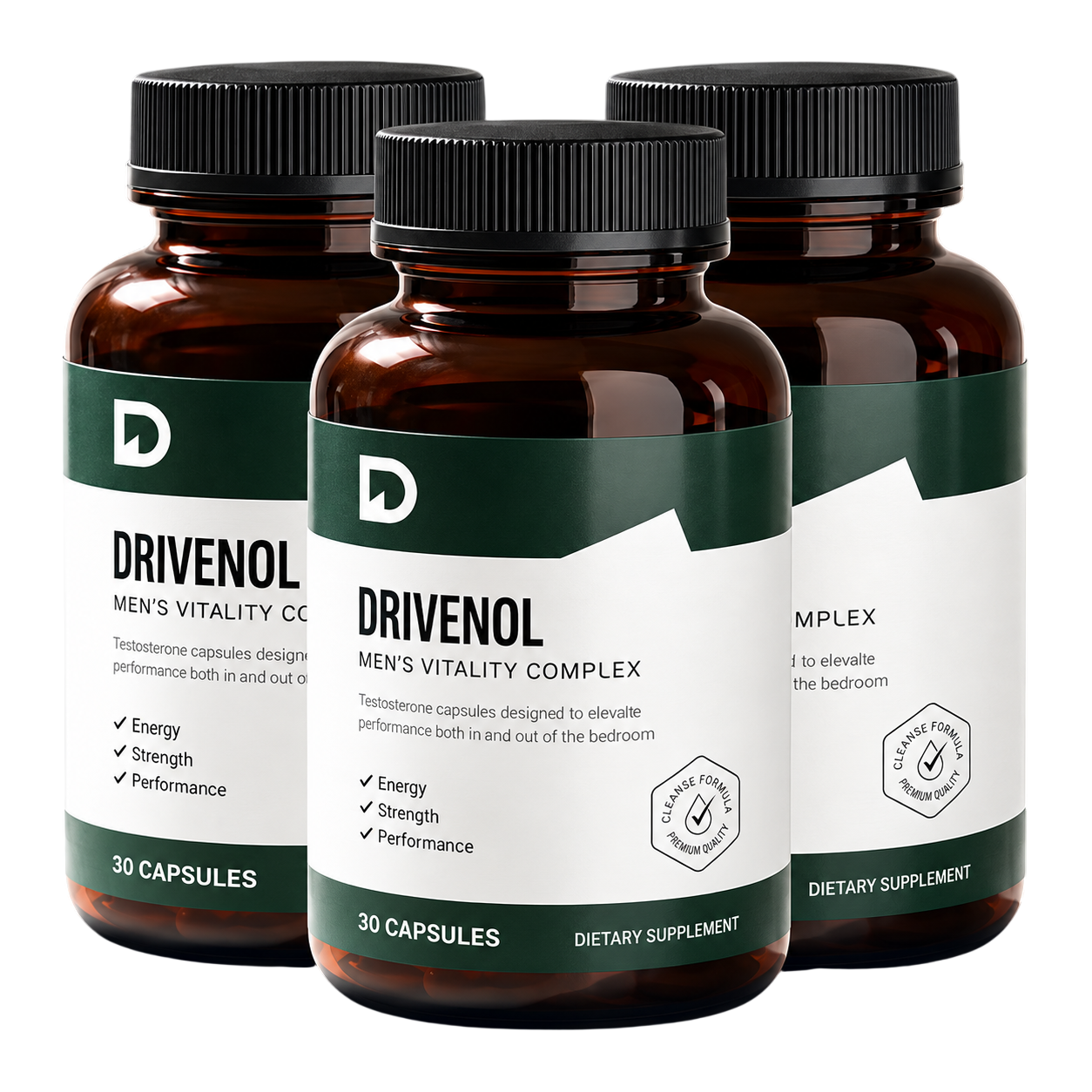
Drivenol is a food supplement, not a medicine, and most people take it without any problem. The effects most commonly reported for its ingredients are mild: restlessness or lighter sleep if taken late in the day, and occasional digestive upset when taken on an empty stomach. It is not suitable for under-18s, or for women who are pregnant or breastfeeding. If you take prescription medication or have a hormone-sensitive or thyroid condition, speak to your GP or pharmacist first.
Is Drivenol safe?
For most healthy adult men, taken at one capsule a day, there is nothing in Drivenol that would be expected to cause a problem. It is a food supplement rather than a medicine, so it is not prescribed, not hormonal and not habit-forming, and it contains four ingredients that have each been used in human studies.
That is not the same as saying it is risk-free, and any brand telling you a supplement has no side effects is overselling. Botanical ingredients do have effects — that is the point of taking them — and effects mean some people will notice something they did not want. The realistic picture is that the reported effects are mild, they usually appear in the first week or two, and they usually settle or disappear when the timing or the food you take it with changes.
The two situations that genuinely need care are prescription medication and existing medical conditions. Those are covered further down, and in both cases the answer is the same: show the label to your GP or pharmacist before you start.
What each ingredient is associated with
Every ingredient is on the label with its amount. Here is what is most commonly described in published human research for each one, and what it means in practice.
| Ingredient | Most often reported | Practical note |
|---|---|---|
| Tongkat Ali root extract | Restlessness, lighter sleep, mild digestive upset | Take it in the morning rather than the evening |
| KSM-66 Ashwagandha root extract | Drowsiness, loose stools, stomach discomfort; rare case reports of liver injury with ashwagandha products | Take it with food if your stomach is sensitive; stop and seek advice for jaundice or persistent nausea |
| Boron | Well tolerated at supplemental levels; nausea only at intakes far above them | Do not stack several boron-containing products |
| Epimedium extract (icariin) | Dry mouth, flushing, dizziness, occasional palpitations at higher intakes | Stick to the labelled dose and do not double up |
This summarises what is commonly described for these ingredients. It is not a complete list, and individual responses vary. Anything severe, or anything mild that persists beyond a few days, means stopping and speaking to a pharmacist or GP.
What is normal in the first two weeks — and what is not
Most people notice nothing at all in the first fortnight beyond, eventually, the reason they started. Where something does show up, it is almost always in this first stretch while your routine settles.
- Usually settles: a slightly lighter night's sleep, a little stomach heaviness on an empty stomach, mild loose stools for the first few days, a mild headache in the first week.
- Worth changing something for: sleep still disturbed after a week (move the capsule to first thing in the morning), stomach upset that keeps returning (take it with a proper meal rather than a coffee).
- Stop and get advice: a rash, palpitations, dizziness that does not pass, yellowing of the eyes or skin, dark urine, unusual or persistent nausea, or anything that simply feels wrong.
If you stop because it does not agree with you, the 30-day guarantee is there for exactly that reason — you are not stuck with bottles you cannot use.
Medicines and conditions to check before you start
This is the part that matters most. The interactions below are discussed in relation to the ingredients in Drivenol — mainly ashwagandha and Epimedium — and none of them mean you definitely cannot take it. They mean the decision belongs to someone who knows your medical history.
- Blood-pressure medication — ashwagandha and Epimedium are both discussed in relation to blood pressure.
- Diabetes medication — ashwagandha is discussed in relation to blood sugar.
- Thyroid medication, or any thyroid condition — ashwagandha is discussed in relation to thyroid hormone levels.
- Blood thinners such as warfarin, and antiplatelet medicines.
- Sedatives, sleeping tablets and anti-anxiety medication.
- Nitrates for angina, and other heart medication.
- Immunosuppressants, and any autoimmune condition.
- Any hormone-sensitive condition, including prostate conditions.
- Liver or kidney disease.
- Surgery booked in the next fortnight — tell your clinician what you are taking.
This list is not exhaustive. If you take anything on prescription at all, the safest route is a two-minute conversation with your pharmacist, with the bottle or the ingredient list in front of you.
Who should not take Drivenol at all
- Anyone under 18.
- Women who are pregnant, breastfeeding or trying to conceive — it is formulated for men and has not been assessed for use by women.
- Anyone allergic to any listed ingredient.
- Anyone already taking a separate Tongkat Ali, ashwagandha, boron or Epimedium product, unless they stop the other one — the doses stack.
- Anyone whose GP or specialist has advised against botanical supplements for their condition.
It is also not a replacement for treatment. If you have been diagnosed with low testosterone, or you suspect you have, that is an NHS conversation rather than a supplement decision.
Taking it safely: dose, timing, food and stacking
- One capsule a day, and no more, whatever you read elsewhere. More does not work faster.
- Take it in the morning, so any mildly stimulating effect is not competing with your sleep.
- Take it with food for the first week or two if your stomach is easily upset, then move it wherever suits you.
- Do not run it alongside another testosterone-support, Tongkat Ali or ashwagandha product.
- Keep the bottle closed, out of direct sunlight, and out of reach of children.
- Give it several weeks before judging whether it suits you — but stop immediately if something feels wrong.
If you miss a day, simply take the next capsule as normal; there is no need to double up. If you accidentally take two in one day, skip the following day and carry on.
What to do if you have a reaction
Stop taking it. For anything mild, that is usually all that is needed and the effect fades within a day or two.
For anything severe — swelling of the face, lips or throat, difficulty breathing, a rash spreading rapidly — treat it as an emergency and call 999. For anything worrying but not an emergency, call 111 or speak to your pharmacist.
Keep the bottle and the batch number. Tell us so we can look at the batch, and you can also report a suspected reaction to a food supplement through your local authority's trading standards team.
Alcohol, driving, long-term use and stopping
Alcohol: there is no known specific interaction, but alcohol works directly against the things people take this kind of supplement for — sleep quality, energy and recovery. It will not make the supplement unsafe; it will make it harder to tell whether it is doing anything.
Driving and machinery: there are no stimulants and nothing sedating at the labelled dose. Ashwagandha is occasionally reported as mildly drowsy-making, so if that is how it affects you, see how you feel before a long drive in the first few days.
Long term: honest answer — long-term studies on this exact four-ingredient combination do not exist. Most published trials on the individual ingredients run for eight to twelve weeks. A sensible approach is to take it consistently for a few months and then review how you feel, rather than taking anything indefinitely without thought.
Stopping: there is no withdrawal and no need to taper. You can stop whenever you like, and there is no subscription to cancel — every order here is a one-off purchase.
Common questions
Sources
Where this page refers to research, guidance or consumer rules, these are the references used. We link to the source so you can read it yourself.
This page is general information about food supplements and is not medical advice. Drivenol is a food supplement and is not intended to diagnose, treat, cure or prevent any disease. If you have a health concern, or you take prescription medication, speak to your GP or pharmacist.